 blog
High Value Signs vs JGX Group: How to Choose
Last Updated: November 3, 2026
Quick Summary
Choosing between high value signs vs jgx group depends on your project type, installation needs and the detail in each quote, since the verified public information does not include a performance comparison. Use the same criteria with both providers: specialization, in-house installation, design intake, permits and removal. Compare line items rather than totals to judge which company fits your job.
- Start by listing exactly what you need: storefront, fleet, interior or event graphics.
- Ask both companies identical questions about specialization, in-house installation and proof of comparable work.
- Ask for quotes that separate design, fabrication, installation, removal and permit fees.
- Get warranty terms, material brands and surface prep plans in writing before committing.
Table of Contents
- What Each Company Offers: High Value Signs Services and JGX Group Signage Services
- Comparing Services Side by Side
- Commercial Sign Company Comparison: The Criteria That Matter
- Materials, Durability, and Warranty Questions to Ask
- Project Timelines, Installation, and Permit Considerations
- How to Get a Commercial Signage Quote and What Affects Pricing
- Choosing the Right Partner for Your Next Sign Project
- Frequently Asked Questions
High value signs vs JGX Group is a question many Dallas-area businesses ask before they commit to commercial signage, and the answer depends on what you need built, how it will be installed and how much detail you want in the quote.
We will be direct about one limitation at the outset: the verified information available to us does not include a dated, side-by-side performance comparison of these two providers. What follows is a framework for comparing them on fair terms, not a verdict on which is better.
What Each Company Offers: High Value Signs Services and JGX Group Signage Services
High Value Signs describes its work as custom banners, storefront signs and graphics. JGX Group is described as a sign, design and print shop in Dallas.
Start by listing exactly what you need. A single exterior sign, a fleet of vehicle graphics, interior wall graphics and event banners each call for different materials and installation skills. A provider that handles one of these well may not be the strongest choice for another.
Comparing Services Side by Side
The ranking results for this query are mostly individual company pages and directory listings, so a fair side-by-side evaluation is the piece most buyers never get. The framework below is built to be filled in with answers from each provider, not to assume differences that cannot be verified. Use the same rows for both companies so the comparison stays honest.
A criteria-based comparison framework
| Comparison criterion | What to ask High Value Signs | What to ask JGX Group | Why it matters |
|---|---|---|---|
| Core specialization | Which sign categories do you produce most often in a typical month? | Same question, same wording | A shop that produces storefront signs weekly will usually outperform one that treats them as occasional work |
| In-house vs. outsourced | Which steps happen in your facility and which are subcontracted? | Same question | Outsourced fabrication or installation adds handoffs, and handoffs are where timelines and accountability slip |
| Design intake | Do you accept client-supplied vector files, or do you require a design deposit? | Same question | Determines whether your existing brand assets are usable or whether you pay for re-creation |
| Installation crew | Is installation performed by your employees or a third-party crew? | Same question | The installing crew is responsible for surface prep, which drives how long the graphics last |
| Permit handling | Do you file sign permits, or does the property owner? | Same question | Exterior sign approvals are handled at the municipal level and vary by sign type and size |
| Removal and replacement | What is your policy and pricing for removing old graphics? | Same question | Removal is frequently omitted from initial quotes and becomes a change order later |
| Proof of comparable work | Can you show completed projects in my sign category and surface type? | Same question | Past work in the same category is the closest thing to a performance record available before you buy |
How to read the answers
A useful pattern to watch for is consistency between what a company says it does and what it can show. If a provider claims storefront and vehicle work but can only produce examples in one category, treat the other category as unproven for your purposes.
Watch out: a quote that lists a total price without breaking out design, fabrication, installation, and removal is not comparable to one that does, and comparing the two totals will lead you to the wrong conclusion.
Project-fit guidance by business type
Match the provider to the job rather than to a general reputation:
- Retail storefront and window graphics: prioritize window film experience, glass surface prep, and whether installation happens after hours so the store can stay open.
- Office and lobby branding: prioritize interior wall graphic experience, substrate selection for drywall and painted surfaces, and design support if your brand files are incomplete.
- Fleet and vehicle graphics: prioritize full versus partial wrap capability, removal policy for leased vehicles, and whether the installer works indoors or in a controlled bay.
- Event and temporary signage: prioritize turnaround time and banner material suited to short-term outdoor exposure rather than long-term durability.
- Building identification and exterior signs: prioritize permit familiarity with the local municipality and mounting method for your wall or monument type.
This framework will not tell you which company is better in the abstract, because neither provider's verified public information supports that claim. It will tell you which one is better matched to your specific project, which is the decision you are actually making.
Commercial Sign Company Comparison: The Criteria That Matter
Most buyers focus on price first. That is understandable, but it is rarely the best starting point. Commercial signage affects how customers see your business for years, so weigh these criteria together:
- Fit with your project type. Confirm the company regularly produces the sign category you need.
- Design capability. Decide whether you have a finished design or need help creating one.
- Installation responsibility. Find out whether the same team that produces the graphics also installs them.
- Communication. Note how quickly each company responds and how clearly it explains options.
- Local service. Confirm the company serves your location and can reach the site for installation.
A common mistake is comparing quotes before defining the project. Two quotes are only comparable if they cover the same square footage, materials and installation scope.
Materials, Durability, and Warranty Questions to Ask
Durability depends heavily on the material. Ask each provider:
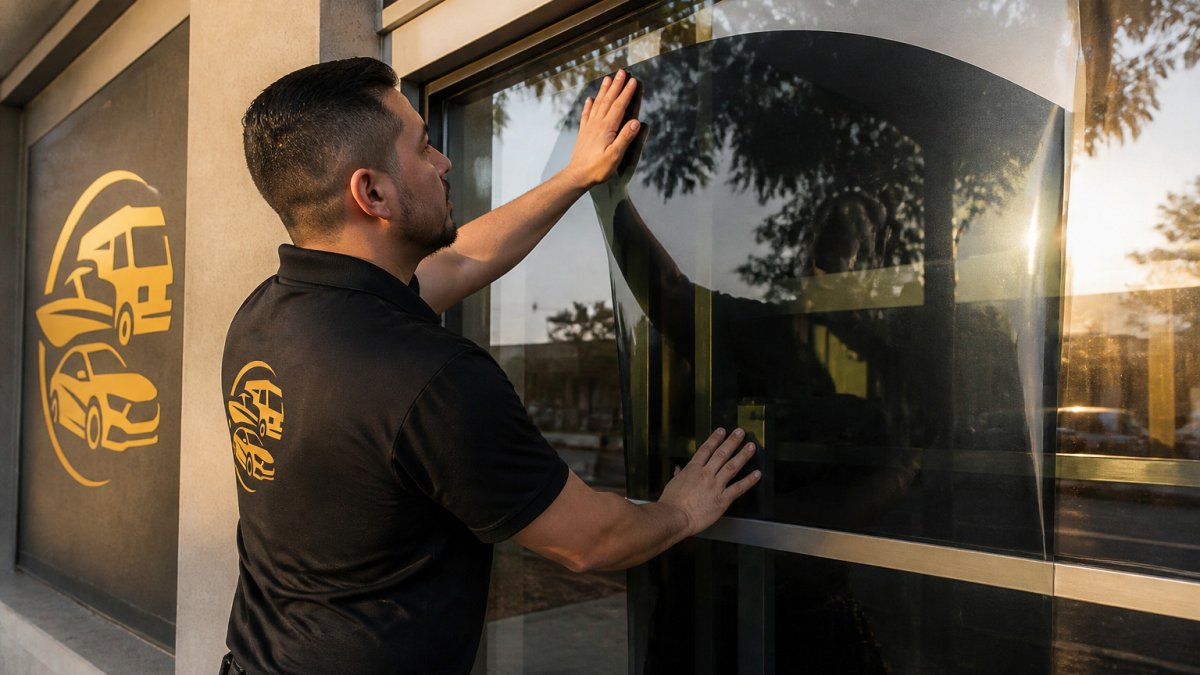
- What vinyl or film brand do you use, and what is its expected outdoor lifespan?
- Is the laminate UV-protective for sun-exposed surfaces?
- What warranty covers fading, peeling and adhesion failure, and for how long?
- What maintenance should we expect, and what can damage the graphics?
- How do you handle removal at the end of the project?
Get these answers in writing. A warranty that is only described verbally is hard to enforce later. Be careful with any provider that cannot name its materials, since that often signals a lower-grade product.
We learned the hard way on early jobs that a vinyl which looks fine on day one can lift at the edges within a year if the surface was not properly cleaned and prepped.
Project Timelines, Installation, and Permit Considerations
Timelines usually include design approval, production and installation scheduling.
Permits matter for many exterior signs. Requirements vary by city and by sign size, so ask each provider whether they handle permit applications or whether you will need to arrange them.
Installation method also shapes the timeline. Some projects require a crew on site for several hours. Others, like window film, can take a single visit.
How to Get a Commercial Signage Quote and What Affects Pricing
None of the ranking results for this query publish prices or explain what drives cost, which leaves buyers comparing totals they cannot interpret. This section explains the cost drivers and the quote mechanics so you can compare High Value Signs and JGX Group on equal terms. Pearl Wrapz does not publish fixed prices for this work because scope varies too widely, and the same is true of most commercial sign providers.
The cost drivers behind a commercial signage quote
Every line in a sign quote traces back to a small set of variables. Ask each provider to price against these explicitly:
- Square footage and dimensions. Material cost scales with area, but so does installation labor. A large single graphic and several small ones of the same total area often price differently because of setup and handling time.
- Material grade. Cast vinyl, calendared vinyl, rigid substrates, and window films have different cost and lifespan profiles. Cast film conforms to curves and rivets and is the standard choice for vehicle work; calendared film is common for flat interior surfaces.
- Laminate and UV protection. A UV-protective overlaminate adds cost upfront and extends outdoor life. Ask whether the quoted price includes laminate or whether it is an add-on.
- Design work. Client-supplied vector artwork usually reduces cost. Raster files, low-resolution logos, or brand assets that need re-creation add design hours.
- Surface preparation. Cleaning, scraping old adhesive, and priming porous surfaces are labor items. A quote that omits surface prep is incomplete.
- Installation complexity. Height, access, scaffolding, after-hours scheduling, and whether the surface is glass, painted drywall, brick, or a vehicle panel all change labor.
- Permits. Exterior sign permits involve municipal fees and administrative time. Confirm whether the fee is passed through at cost or marked up.
- Removal and disposal. Removing existing graphics and disposing of materials is a separate scope item that is often left out of the first quote.
- Quantity and repetition. Multiple identical units reduce per-unit design and setup cost, which is why fleet work is often priced per vehicle rather than per graphic.
What to send with a quote request
Give both providers identical information so the quotes are comparable:
- Dimensions or square footage for each graphic, measured rather than estimated
- Surface type and condition, including photos of the installation area
- Whether you have final vector artwork or need design help
- Desired installation date and any access restrictions, such as loading dock hours or building management rules
- Whether existing graphics need removal
How to read the quote you get back
Ask for a written quote that separates design, fabrication, installation, removal, and permit fees. Compare line items rather than totals. A lower total that excludes installation or laminate is not a lower price for the same work; it is a price for less work.
Watch out: if one quote is dramatically lower than the others, ask what is excluded before treating it as a better deal, because the difference is usually materials grade, omitted installation, or omitted surface prep rather than efficiency.
Questions that surface hidden costs
- Is the quoted price firm, or does it change if site conditions differ from the photos?
- Who pays for permit fees, and are they passed through at cost?
- What is the change-order rate if artwork revisions are needed after approval?
- Is there a trip charge or minimum for installation at a distant site?
- What does removal of the new graphics cost at the end of their life?
Get the answers in writing and attach them to the quote. A provider that will not put scope and exclusions in writing is telling you something about how the project will go.
Choosing the Right Partner for Your Next Sign Project
Choose the provider whose services match your project, whose materials and warranty you understand, and whose quote covers the full scope. If you are in North Texas or southern Oklahoma and your project involves vehicles, storefront windows, interior walls or floors, Pearl Wrapz can be part of that evaluation.
Whichever company you choose, get the scope, materials, warranty and installation plan in writing before you commit. A clear quote and a clear plan are the best signs of a reliable partner.
Frequently Asked Questions
What services does High Value Signs offer?
High Value Signs offers custom banners, storefront signs, and graphics, according to its website. Before deciding, confirm whether the company handles design, fabrication and installation for your project type, and ask for a written scope. Services can change, so check the current offerings directly with the provider.
What services does JGX Group offer?
JGX Group is a Dallas-based sign, design, and print shop, according to its website. Ask whether it handles design, fabrication, printing and installation together, since that affects how many vendors you manage. Confirm the current service list and any project minimums directly with the company.
What should I compare when choosing a commercial sign company?
Compare the services each company actually provides, including design, production and installation. Ask about materials, expected lifespan, warranty terms and maintenance guidance. Request a written timeline and a clear list of what the quote includes. Verify experience with projects similar to yours, such as storefront or fleet work.
How do I get a quote for a custom business sign?
Prepare your sign dimensions, mounting surface, location, desired materials and installation needs before contacting providers. Pricing depends on size, materials, design work, quantity and installation complexity, so there is no standard figure to rely on. Request a written quote in USD that itemizes design, production, installation and any permit fees.