 Listicle
Are Custom Floor Decals Worth It for Event Branding?
Last Updated: October 29, 2026
Quick Summary
Custom floor decals are worth it for event branding when they do a job a banner cannot, such as directing foot traffic or marking a sponsor zone. Floor graphics sit where guests already look, and retail evidence shows sales increases of 10% to 13% for products promoted with floor graphics and mats. Choose slip-resistant material and test it on your actual floor first.
- Confirm the slip rating and ask whether the material was tested on your specific floor surface.
- Use a removable adhesive with a matte or textured laminate for a one- to three-day trade show.
- Order a sample and apply it to the actual floor for at least 24 hours before committing to a full run.
- Sweep and mop the floor and let it dry completely to prevent bubbles and edge lift.
- Ask suppliers for their removal method and test a small corner before the event.
Table of Contents
- Why Custom Floor Decals Work for Event Branding
- How We Evaluated These Floor Decal Options
- Top Custom Floor Decal Options for Events
- Slip-Resistant Floor Graphics for Guest Safety
- Custom Floor Stickers for Carpet and Hard Surfaces
- Floor Decal Installation Tips for Event Crews
- Floor Decal Removal Process and Contingency Planning
- Requesting a Quote for Your Next Event Floor Graphics
- Frequently Asked Questions
Why Custom Floor Decals Work for Event Branding
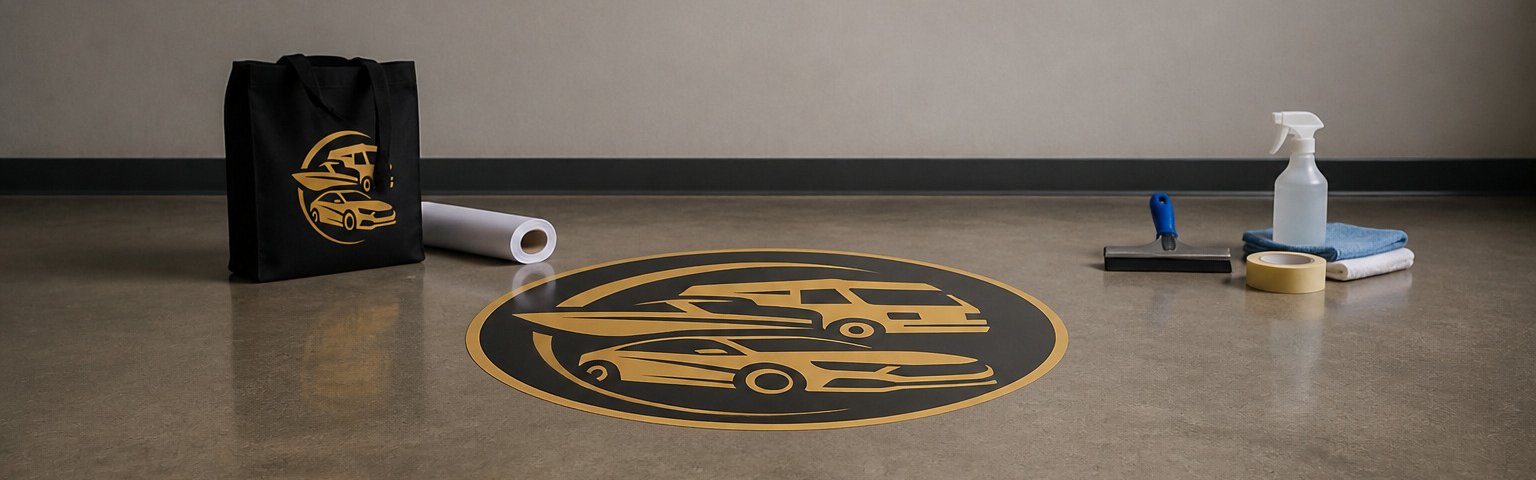
Floor graphics put your brand where guests already look. At Pearl Wrapz, we see event floors as one of the most underused branding surfaces, because attendees walk over them, pause on them, and photograph them without being asked. Custom floor decals are printed vinyl graphics applied directly to a floor to carry a logo, message or wayfinding cue. Browse branded floor decals and event graphics to see the options.
Floor graphics are also being used as a serious sales-promotion medium. Wall murals, storefront and floor graphics installation offers installation-only commercial vinyl services. WhatTheyThink's report on how floor graphics are transforming retail spaces reports sales increases of 10% to 13% for products promoted with floor graphics and mats, and a 16% increase for one grocery brand. Those results come from retail, not events, so treat them as directional evidence rather than a guarantee for your booth.
Event use follows the same logic. Suppliers describe custom floor graphics as a way to guide guests, promote sponsors and define booth or branded zones, a point made by AMI Graphics on event floor graphics. In our view, the value is strongest where a floor decal does a job a banner cannot, such as directing foot traffic or marking a sponsor zone.
How We Evaluated These Floor Decal Options
We judged each option on five practical questions. Does it hold up to foot traffic? Does it grip well enough to be safe? Can it be sized and shaped for your space? Is it clear about pricing? And does it come off clean when the event ends?
We also weighed fit for a short event against a longer install, since a decal that works for a three-day trade show can be the wrong material for a permanent retail floor.
Pricing depends on size, quantity, material and delivery, so request a quote from each provider.
Top Custom Floor Decal Options for Events
Pearl Wrapz is our own service. We handle the full process, from concept and design to professional installation, and we also install client-supplied graphics through a local partner. Pricing depends on quantity, dates and delivery, so request a quote from our website.
Quick Comparison of Pricing, Finishes, and Sizes
| Provider | Published Starting Price | Pricing Model | Key Finish or Feature | Best For |
|---|---|---|---|---|
| Pearl Wrapz | Quote on request | Per project | Design through installation | One provider for design and install |
| Square Signs | Not published | Per project | Durable vinyl, custom shapes | Heavy-traffic events |
| VistaPrint | Not published | Per unit | Non-slip coating | Small events, quick turnaround |
| Best of Signs | Not published | Per unit | Clear or frosted | Directional and safety signage |
| 4over4 | $34 per unit | Per unit | Anti-slip laminate | Slip-rated safety needs |
| G-Floor Graphic | Not published | Per project | Full-surface printable material | Large floor transformations |
| GotPrint | Not published | Per unit | Vinyl, logo and text | Trade show booths |
| Front Signs | Not published | Per project | Custom shapes and sizes | Unique promotional shapes |
| NY Printing Solutions | Instant online quote | Per unit | Online customization | Quick, localized orders |
| SpeedPro | Not published | Per project | Large-format, installation | Large corporate events |
Slip-Resistant Floor Graphics for Guest Safety
A floor graphic that looks great but makes people slip is a liability, not a branding win. Professional buyers' guides for 2026 stress that event floor graphics should prioritize slip-resistant materials and meet ANSI compliance standards, while still allowing a clean removal, as noted in GraphiCabin's 2026 professional buyers' guide.
Ask every supplier which slip rating their material carries and whether it was tested on the surface you will use. A material rated for sealed concrete may behave differently on polished tile or carpet. Ask for the test documentation, not just the marketing claim.
Watch out: a glossy laminate can look safe in a showroom and turn slick once guests walk on it wet. Test a sample on your actual floor before the event.
Custom Floor Stickers for Carpet and Hard Surfaces
The right construction depends on three variables: surface type, expected foot traffic, and how long the graphic must stay down.
Hard, non-porous surfaces. Sealed concrete, polished tile, terrazzo, and sealed hardwood hold pressure-sensitive vinyl well when clean and fully cured. Use a removable or semi-permanent adhesive with a textured or matte overlaminate, which hides scuffs and reads better under venue lighting than gloss film.
Carpet. Standard vinyl adhesive is the wrong tool for carpet. Carpet needs a low-tack adhesive designed for pile or a rigid or semi-rigid backing that bridges the pile instead of bonding to it. Short-pile commercial carpet and carpet tile accept these better than plush or looped carpet, where the graphic can rock, curl, or leave crush marks.
Other surfaces worth flagging. Burnished polished concrete can be slicker than it looks; a textured laminate helps. Epoxy-coated and painted floors can delaminate under aggressive adhesive, so test a corner first. Outdoor asphalt and concrete need a different adhesive and laminate than indoor vinyl, plus a surface temperature within the manufacturer's range at application.
Match material to event duration. For a one- to three-day trade show, a removable adhesive with a matte or textured laminate is usually enough, and clean removal matters more than long-term wear. For a week-long activation or multi-week install, step up to a semi-permanent adhesive and heavier overlaminate. For anything measured in months, treat it as a permanent graphic and plan for professional removal.
Floor Decal Installation Tips for Event Crews
Installation is where most floor graphics succeed or fail. If you have client-supplied artwork but need hands-on help, see the installation partner support for printers, sign shops and project teams. A decal that goes down with bubbles, wrinkles, or dust underneath will look cheap on day one and lift at the edges by day two. The fix is a repeatable workflow, not a steady hand.
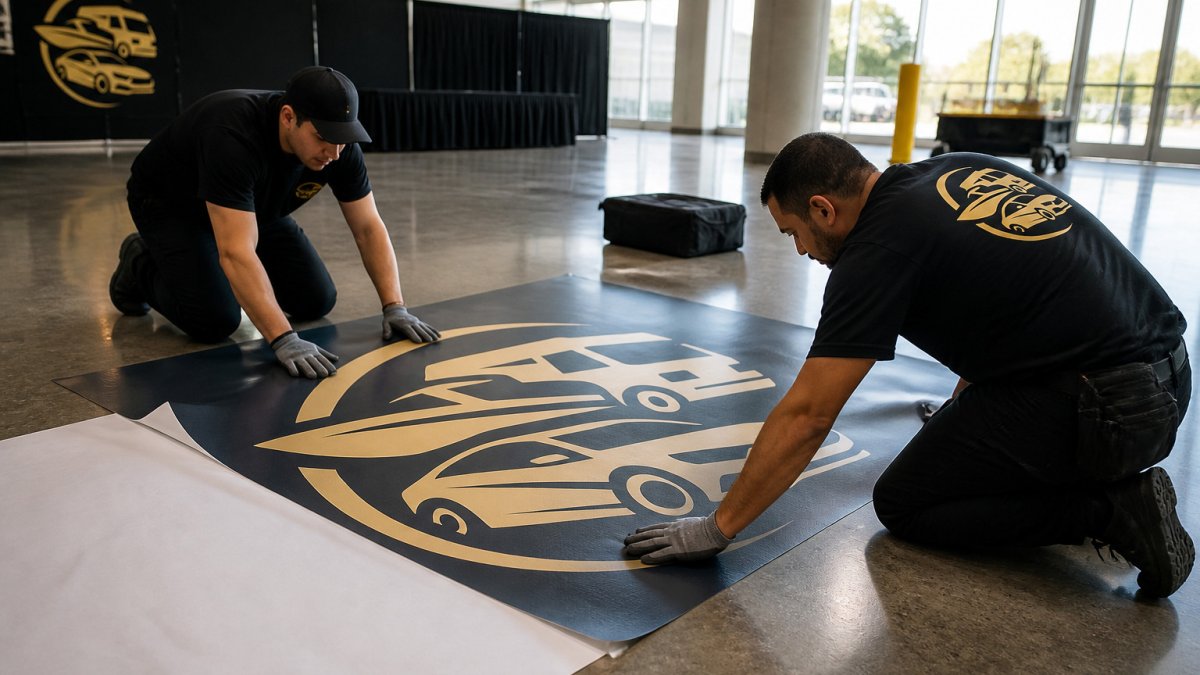
Before install day. Confirm the floor is cleaned and fully dried, and that room temperature is within the adhesive manufacturer's range, a comfortable indoor band, not a cold loading dock or hot tent. Stage decals flat, not rolled tight, for at least a few hours so they relax. Have the right tools: a felt-edged squeegee, utility knife, tape measure and chalk line or laser level, a lint-free cloth, and the supplier's specified cleaner.
Step-by-step application.
- Sweep and then mop or wipe the floor, and let it dry completely. Dust and grit are the most common cause of bubbles.
- Mark alignment with a chalk line or laser level. For a multi-decal layout, mark every position before peeling any liner.
- Lay the decal in place with its liner still on, and check the position from the entrance sightline, not just from above.
- Peel back a small section of liner, anchor that edge, and smooth from the center outward with the squeegee, working air to the edges.
- Continue peeling and smoothing in sections rather than peeling the whole liner at once, which is how wrinkles start.
- Trim any excess with a sharp blade against a straight edge, and re-smooth the cut edges.
- Give the adhesive time to cure before heavy foot traffic; follow the supplier's cure guidance rather than guessing.
Fixing common problems.
- Bubbles: small ones often work out with firm squeegee pressure from the center outward. For stubborn bubbles, prick with a pin at the edge of the bubble and smooth. Do not slice across the graphic face.
- Edges lifting: clean the edge, warm it gently with a handheld dryer on low, and press with the squeegee. If the edge keeps lifting, the floor may be too cold or too dirty for the adhesive.
- Wrinkles: lift back to the wrinkle, re-lay, and smooth in smaller sections.
- Last-minute layout changes: keep spare decals and a roll of the same material on hand. Moving a decal that has already cured is usually a replacement job, not a repositioning job.
Pearl Wrapz offers a local installation partner for client-supplied graphics, which can help a printer, sign shop, or event crew that has the artwork but not the installers. Pearl Wrapz floor graphics and installation services covers that support.
Floor Decal Removal Process and Contingency Planning
Removal is the question event planners ask last and should ask first. A decal that peels cleanly after three days is a success. One that leaves adhesive residue or damages a hardwood or concrete floor can cost you the venue deposit.
Ask suppliers for their recommended removal method and whether their adhesive is designed for clean removal. Test a small corner in an inconspicuous spot before the event. Keep a cleaner, a scraper and a spare decal on hand in case a section tears or lifts mid-event.
Track foot traffic at the zone and any sponsor interactions, so you can judge the decal's return against its cost next time.
Requesting a Quote for Your Next Event Floor Graphics
Before you request a quote, gather four details: the event dates, the floor surface, the approximate foot traffic and the size or shape you need. With those in hand, most providers can give you a realistic number.
Pearl Wrapz builds custom floor graphics for event branding, and we can coordinate installation for your event. Pearl Wrapz's service overview for floor decals and commercial graphics shows the range of services we offer, from floor decals to vehicle wraps and storefront graphics. Request a quote through our website to get current pricing for your project. You can also review the overview of floor decals and related graphics before you ask.
Frequently Asked Questions
What materials are best for temporary event floor decals?
For temporary events, most printers recommend vinyl with a laminate overlay, because it resists scuffing from foot traffic and can be lifted cleanly afterward. Clear and frosted finishes suit directional and safety messaging, while full-color printed vinyl works best for sponsor logos. Ask your supplier which adhesive they use and whether it is designed for short-term placement, since the wrong adhesive can leave residue or lift too easily on carpet or tile.
Can floor decals be applied to carpet and concrete?
Yes, but the surface determines the adhesive and finish you need. Hard surfaces like sealed concrete, tile, and laminate usually accept standard floor vinyl well. Carpet calls for a removable adhesive or a stickers-for-carpet product, since permanent adhesive can damage fibers. Clean and dry the floor before application, and confirm with the supplier that the product is rated for your specific surface.
Are custom floor decals slip-resistant and safe for guests?
Not all of them. Many standard decals are glossy and become slippery when wet, so look for a product with an anti-slip laminate or a slip-resistant rating. Printers serving event and trade show markets often recommend slip-resistant materials paired with a clean-removal adhesive. Place graphics away from high-traffic walkways and entrances where wet footwear is common, and keep spare decals on hand to replace any that wear down.
How do you remove floor decals without damaging the surface?
Remove decals after the event by peeling slowly at a low angle, and warm stubborn edges with a heat gun on a low setting if needed. Use a mild adhesive remover on any residue, then wipe the area clean. Test removal on a small inconspicuous spot first, especially on carpet or newly sealed concrete, because aggressive adhesives can pull fibers or dull the finish.