 Comparison
Are Custom Retail Signage Design Services Worth It?
Last Updated: November 21, 2026
Quick Summary
Custom retail signage design services are worth it when you buy design, production, and installation as one package, because a strong file installed badly still looks cheap. Score providers on design, materials, installation, turnaround, warranty, and line-item total cost before comparing quotes.
- Ask for total project cost in writing, broken into design, material, print, finishing, freight, and install lines.
- Outdoor retail signage must be readable in the two to three seconds a driver or pedestrian gives it.
- A 2026 survey commissioned by Frank Mayer and Associates found 63% of shoppers were influenced by retail displays.
- Floor graphics need a slip-resistant laminate plus a substrate matched to sealed concrete, tile, or carpet.
- Gather surface measurements, photos, vector logo files, and a rough timeline to cut a week off most projects.
Table of Contents
- What Custom Retail Signage Design Services Actually Cover
- How to Compare Signage Providers Without Getting Burned
- Custom Business Signs Outdoor: Making the Storefront Readable at Speed
- Custom Indoor Signs for Business: Windows, Walls and Floors
- Design Your Own Sign Online vs. Working With a Design Team
- What Custom Retail Signage Design Services Reviews Really Tell You
- Get a Quote on Your Storefront Graphics
- Frequently Asked Questions
What Custom Retail Signage Design Services Actually Cover
Custom retail signage design services are end-to-end programs that take a storefront or interior from raw measurement to installed graphics: concept, artwork, material selection, print production, and physical installation. In practice, that means window vinyl, dimensional lettering, wall murals, floor decals, and point-of-purchase displays, all built around one brand system. The U.S. digital signage market hit $7.44 billion in 2025 and is projected to reach $12.97 billion by 2033, according to Grand View Research's U.S. market forecast, which tells you how much budget is moving toward visual environments.
The scope of these projects typically spans exterior surfaces, interior surfaces, and temporary event or promotional graphics.
What most guides miss is that design and installation are not separable line items. A beautiful file installed badly looks cheap. That is the whole argument for buying the service as one package rather than piecing it together.
You can see the full range of storefront and window graphics we produce if you want a concrete picture of what a project includes.
How to Compare Signage Providers Without Getting Burned
The fastest way to compare signage providers is to score them on six things: design capability, material specification, installation method, turnaround, warranty ownership, and total project cost. Most buyers only ask about price, which is exactly why they get burned, the quoted number rarely reflects what the project actually costs once design revisions, freight, permits, and install labor are added.
Here is the framework we would use:
| What to Check | Weak Answer | Strong Answer |
|---|---|---|
| Design | "Send us a file" | In-house design with proofs, revision limits stated in writing |
| Materials | Unnamed vinyl | Named cast or calendared film, laminate specified by lifespan |
| Installation | Subcontracted, unnamed | Crew named, insured, scheduled with a site survey on record |
| Turnaround | "A few weeks" | Dated production and install calendar with a ship date |
| Warranty | Verbal | Written, covering materials and labor separately |
| Total cost | One lump quote | Line-item breakdown by design, material, print, finishing, freight, install |
Ask for the total project cost in writing, broken into line items. A credible provider will separate design and proofing, substrate and print, finishing (lamination, contour cutting, die-cutting), shipping, permits if required, and installation labor. When those lines are visible, two quotes that look $2,000 apart often turn out to be $400 apart once the missing install or freight line is added back in. A common pattern is a low design quote paired with per-revision fees and a separate install invoice, get the revision count and the install scope in the same document before you compare totals.
Check the workflow, not just the portfolio. Ask who measures the site, who proofs the artwork against the actual surface, who schedules the install crew, and who signs off at completion. A provider that hands off between a sales rep, an outside designer, and a subcontracted installer has three places for accountability to disappear. The strongest answer names one project contact from measurement through punch list.
Compare service coverage honestly. Local providers can offer installation accountability and site visits, while larger national providers may offer standardized processes across multiple stores. If you operate more than a handful of locations, ask any provider how it handles store-by-store measurement variance and whether pricing holds across a multi-site schedule.
For a deeper breakdown of the trade-offs, our guide to finding a Signs Now alternative for retail graphics walks through how to evaluate the options side by side.
Custom Business Signs Outdoor: Making the Storefront Readable at Speed
Outdoor retail signage has one job: be read in the two to three seconds a driver or pedestrian gives it. That constraint drives every design decision, from letter height to color contrast to how much copy you allow on the glass.
Small script fonts and low-contrast color pairs fail that test every time.
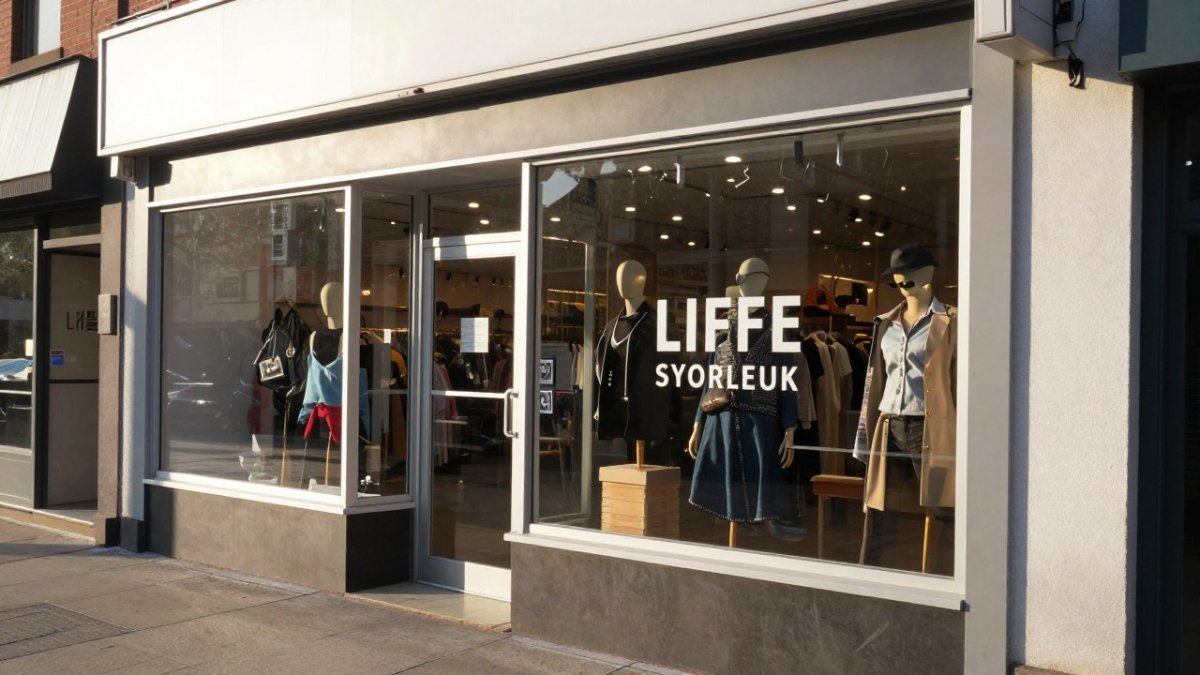
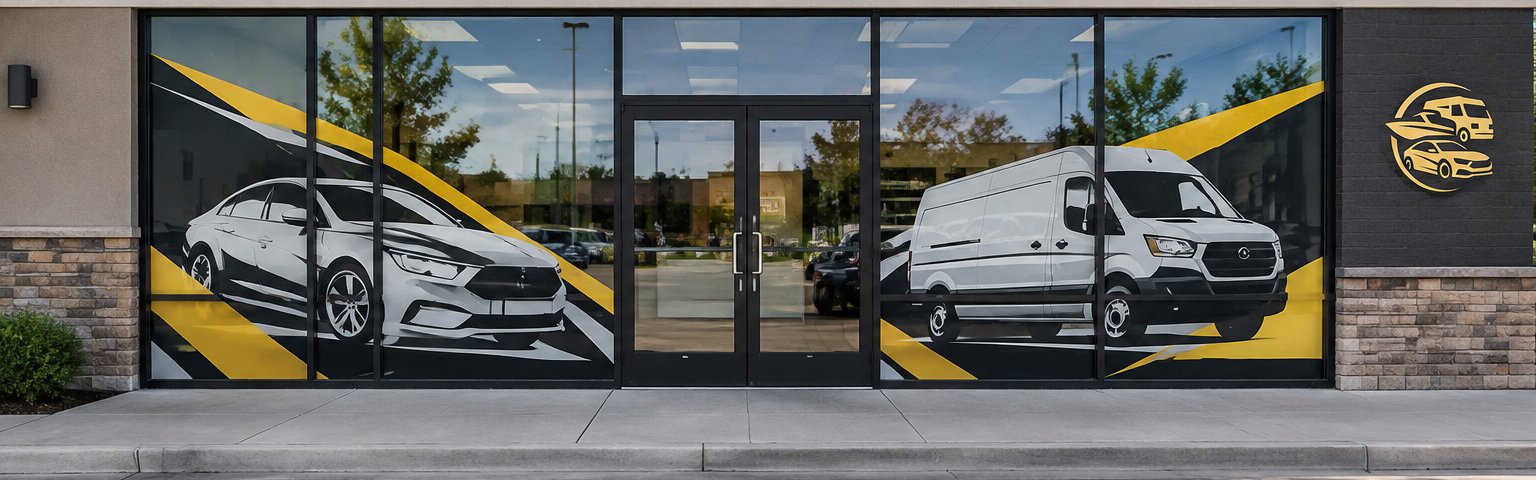
Design choices that help outdoor graphics read at speed include keeping the message short, using high-contrast colors and bold lettering, and using perforated film so shoppers can still see inside.
Covering an entire window in opaque vinyl can reduce the see-in effect, and local sign codes may limit window coverage. Check with your city before you order.
Readability is a design discipline, not a taste question. Our article on designing window graphics people can actually read covers viewing-distance checks in detail.
Custom Indoor Signs for Business: Windows, Walls and Floors
Indoor signage is where brand consistency either holds together or falls apart. A customer who sees a polished storefront and then a bare back wall notices the gap, even if they could not articulate it.
Retail displays carry real weight in the decision. A survey commissioned by Frank Mayer and Associates in 2026 found that 63% of shoppers were influenced by retail displays when comparing similar products, as reported in Shopify's retail signage guide. That number justifies treating interior graphics as a sales tool, not decoration.
Plan by store zone:
- Entry: brand statement, hours, promotional window
- Sales floor: category signage, shelf talkers, point-of-purchase displays
- Fitting rooms: sizing guides, brand story, mirror decals
- Checkout: impulse messaging, loyalty program prompts
Floor graphics deserve their own mention. They take heavy foot traffic and need a slip-resistant laminate plus a substrate matched to the surface, whether that is sealed concrete, tile, or carpet. We produce floor graphics and decals selected around the actual surface and traffic level rather than a generic default.
Design Your Own Sign Online vs. Working With a Design Team
DIY design tools are the right call for a one-off banner. They are the wrong call for a storefront system, and the difference comes down to how many surfaces and viewing distances you are managing.
Online tools give you templates, an upload path, and instant pricing.
A design team can add value in several areas, including preparing artwork for production, recommending materials suited to the surface, reviewing proofs before production, and maintaining a single point of contact through installation.
The honest trade-off: DIY saves money on low-stakes pieces and costs more when a mistake means reprinting an entire window set. If you have never done this before, you do not need to be deeply involved in the design process. A good team will ask about your business, your customers, and your building, then tell you what works.
What Custom Retail Signage Design Services Reviews Really Tell You
Reviews are useful, but not for the reason most buyers think. The star rating tells you almost nothing; the pattern of complaints tells you everything, and the best reviews are the ones that describe what changed after the signs went up, not just whether the crew showed up on time.
When reading reviews, pay attention to repeated patterns in installation, turnaround, design revisions, and photo evidence, as well as reviewers who describe measurable outcomes.
That last signal is the one almost no buyer looks for, and it is the one that separates a provider who treats signage as a design deliverable from one who treats it as a sales tool. A telecom retail signage study by Russell Research's retail signage case study used focus groups and store visits to test signage and naming for a section serving business and consumer shoppers, which is a reminder that signage decisions get tested against real shoppers, not opinions in a conference room. Ask any provider whether they do anything similar, and if they do, ask what they measured.
Measure the signs, not just the install. Before you order, decide what the signage is supposed to move, such as walk-in traffic, engagement with a window promotion, or conversion at a display. Then consider a simple before-and-after comparison against a prior period to see what changed.
Use reviews to pressure-test the claim. If a provider's reviews mention measurable outcomes, ask them how they measured. Reviews that mention only speed and price suggest a more transactional relationship.
The question we hear most is some version of "I found a competitor who quoted less, what am I paying for?" Usually it is installation labor, material grade, and the revision process. Get all three in writing before you compare totals, and ask what the provider will measure once the signs are live.
Get a Quote on Your Storefront Graphics
Pricing depends on quantity, dates, and delivery, so request a current quote from Pearl Wrapz directly rather than relying on published figures.
Before you request a quote, gather four things: measurements of each surface, photos of the space, your logo files in vector format, and a rough timeline. That package cuts a week off most projects.
Our 2026 storefront window branding cost guide breaks down the factors that move a quote up or down so you can budget before the conversation starts.
Retail signage only pays off when design, production, and installation come from one accountable team. Pearl Wrapz handles all three, from concept through professional installation, across storefront window graphics, wall murals, floor decals, and vehicle wraps. We work with retailers, fleet managers, and office teams throughout North Texas and southern Oklahoma, and we install client-supplied graphics too. Get started with Pearl Wrapz and turn every surface in your space into a brand asset.
Frequently Asked Questions
What services are included in custom retail signage design?
A full-service provider typically covers concept and layout, artwork preparation, print production, finishing such as contour cutting and laminating, delivery, and installation. Some also handle site measurement and permit paperwork. Ask up front whether installation is included or quoted separately, because that single line item changes the total project cost more than any other. If you already have finished artwork, confirm the provider will accept client-supplied files and install them rather than design from scratch.
How much does custom retail signage cost?
Pricing depends on square footage, material, finishing, quantity, and whether installation is included, so no honest provider quotes a flat number before seeing your space. Get an itemized quote that separates design, materials, production, and install. Compare quotes on the same scope, not on the headline number: a lower bid that excludes installation or uses thinner vinyl is not cheaper in the end. Ask for current pricing directly from the provider.
Can one company design, print, and install retail graphics?
Yes, and that is usually the safer route. When design, production, and installation sit with one team, someone owns the outcome if a panel arrives the wrong size or a window graphic bubbles during application. Splitting the work across three vendors saves little and creates finger-pointing when something fails. If you use a separate designer, look for an installer who regularly handles client-supplied graphics and will confirm file specs before print.
How long does it take to design and install custom retail signage?
Turnaround depends on scope and revision rounds. Timing depends on the project, and larger pieces such as wall murals and multi-zone rollouts generally take longer because of production and scheduling. Build in time for at least two proof rounds and a site measurement. Ask the provider for a written timeline with dates for proof approval, production, and install, then hold the schedule to those dates.