 Comparison
Outdoor Signage Materials That Hold Up to Weather
Last Updated: November 12, 2026
Quick Summary
Choosing outdoor signage materials for businesses comes down to matching the material to your site's exposure, how long the sign must last, and your budget. Aluminum and Dibond suit long-term rigid signs, while vinyl and PVC fit shorter campaigns and sheltered spots. Compare cost per year of service, not sticker price.
- Aluminum signs typically last 10 to 20+ years with the coating intact.
- Cast vinyl film lasts 3 to 7 years outdoors when laminated.
- Dibond panels last 10 to 15+ years and need only annual washing.
- Mesh banners let wind pass through instead of pulling on the frame.
- Confirm local permit requirements before ordering a permanent sign.
Table of Contents
- How to Match Outdoor Signage Materials to Your Site
- Aluminum, Acrylic, Vinyl, PVC and Dibond: A Side-by-Side Comparison
- The Best Material for Outdoor Signs Depends on Exposure
- Weather-Resistant Outdoor Sign Materials That Survive Sun, Wind and Rain
- Large Outdoor Signs for Business: Rigidity, Mounting and Wind Load
- Outdoor Sign Material Cost: What Drives the Price Up or Down
- Local Codes, Permits and Accessibility Rules for Business Signs
- Get a Quote for Your Storefront, Fleet or Event Graphics
- Frequently Asked Questions
How to Match Outdoor Signage Materials to Your Site
The printed signage market sits at USD 38.38 billion in 2026 and is projected to reach USD 44.06 billion by 2030, according to Research and Markets' printed signage forecast. That growth is driven by businesses that treat their signs as working assets, not decoration. Choosing outdoor signage materials for businesses comes down to three variables: how much sun and wind the sign faces, how long you need it to last, and what you can spend up front.
At Pearl Wrapz, we install graphics on storefronts, walls, windows, floors, and vehicles. The short answer: match the material to the exposure, not to the catalog photo. A sign that looks identical on day one can fail in eighteen months if it faces full afternoon sun.
Below, we break down each material, what drives cost, and the installation details that decide whether a sign survives its first storm season.
Aluminum, Acrylic, Vinyl, PVC and Dibond: A Side-by-Side Comparison
Aluminum is commonly used for rigid, long-term outdoor signs, while vinyl and PVC serve shorter campaigns and budget-sensitive projects. The useful comparison is not which material is "best" but which one survives your exposure for the number of years you actually need.
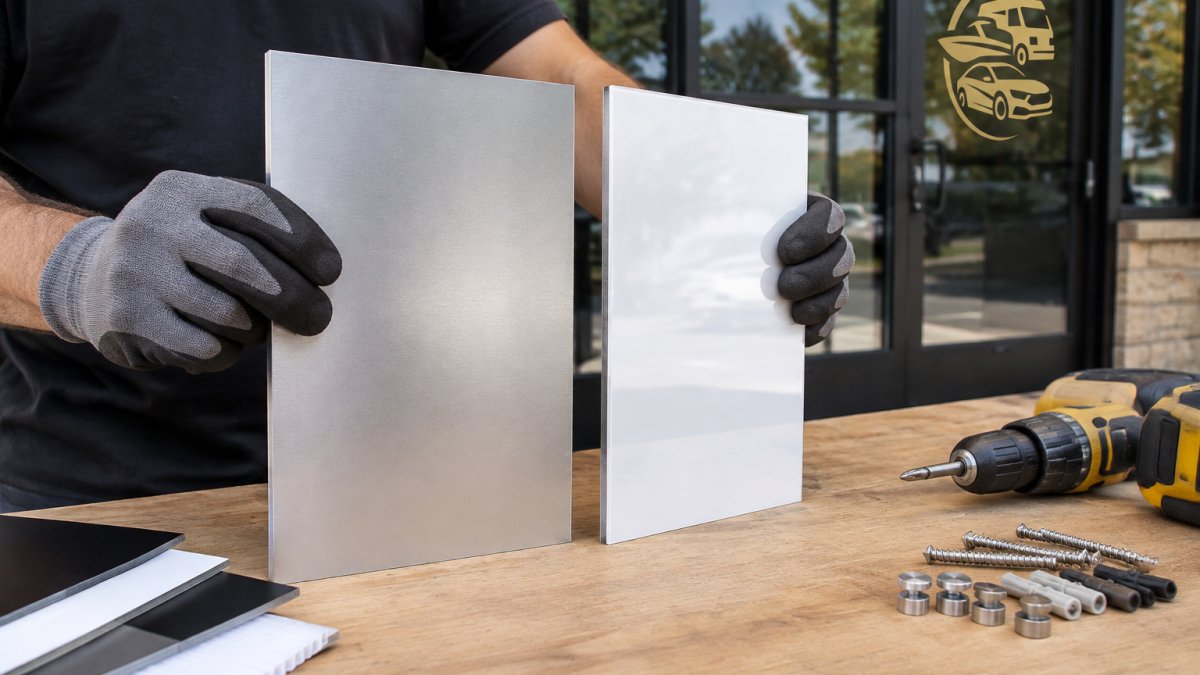
Industry guides from Triton Design's signage trends guide identify aluminum composite panels and acrylic as among the most popular business sign materials, and that tracks with what we see on installs. Here is how the five most common options stack up on the variables that drive replacement decisions.
Lifespan, Maintenance and Upfront Cost at a Glance
| Material | Typical Use | Common Thickness | Expected Outdoor Lifespan | Maintenance Cadence | Relative Upfront Cost |
|---|---|---|---|---|---|
| Aluminum | Permanent exterior signs, monument panels | 0.040 in to 0.125 in sheet | 10 to 20+ years with coating intact | Wash 1 to 2 times per year | Higher |
| Acrylic | Storefront faces, dimensional lettering | 1/8 in to 1/2 in | 5 to 10 years; cracks on impact | Mild soap and water only; no solvents | Mid to high |
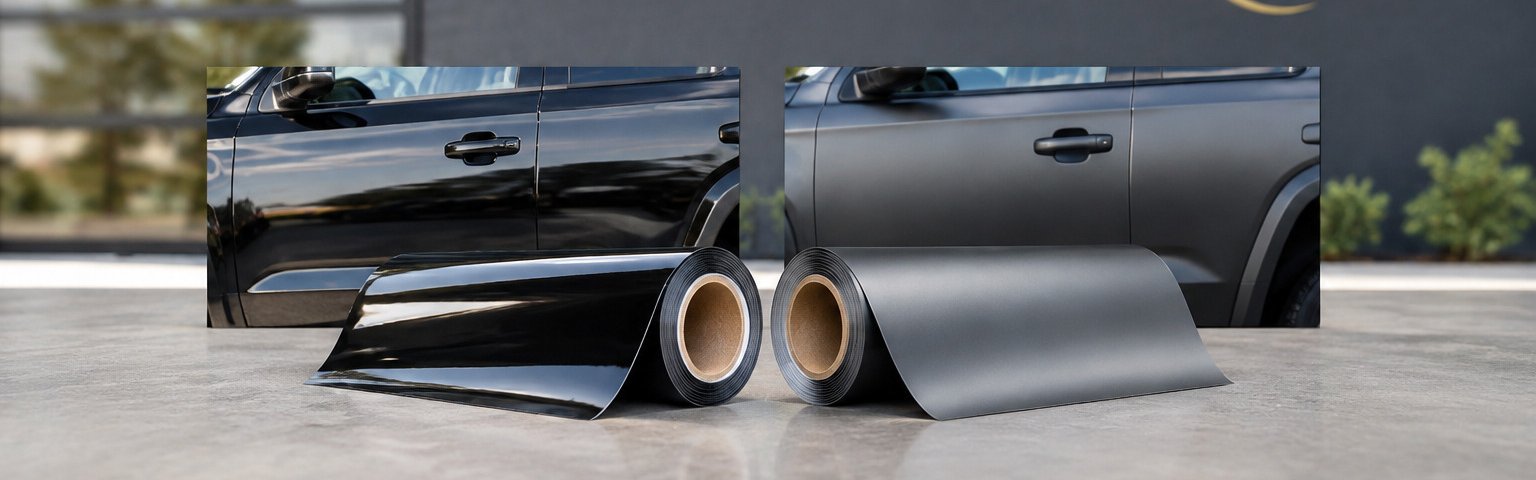
| Vinyl (cast) | Window graphics, banners, vehicle graphics | 2 mil to 4 mil film | 3 to 7 years with laminate | Replace when edges lift | Lowest |
| PVC (expanded) | Lightweight rigid panels, interior and sheltered exterior | 3 mm to 12 mm | 2 to 5 years outdoors; longer indoors | Wipe down; avoid abrasion | Low to mid |
| Dibond (aluminum composite) | Large rigid sign faces, fascia panels | 3 mm to 6 mm | 10 to 15+ years | Minimal; wash annually | Mid to high |
Actual service life depends on sun exposure, mounting method, and coating quality.
What Actually Drives the Cost Difference
Upfront cost is not the material name, it is thickness, coating, print method, lamination, and mounting hardware. Upfront cost depends on material thickness, coating, print method, lamination, and mounting hardware.
Total Ownership, Not Sticker Price
The decision matrix that matters is cost per year of service, not cost per square foot. The most useful comparison is cost per year of service, and the right choice depends on how long the sign needs to stay up.
Watch out: comparing quotes on material name alone hides the thickness and coating differences that determine whether two "aluminum" signs are actually equivalent.
For a deeper look at how substrates, file setup, and production costs interact, our large format printing guide walks through the full process.
The Best Material for Outdoor Signs Depends on Exposure
The best material for outdoor signs is the one that matches your site's actual conditions, not the one with the longest spec sheet. A north-facing wall sign and a freestanding monument sign facing a highway take very different punishment.
A 2026 guide from Arrowhead Sign Company frames selection around wind, UV, and weather resistance, recommending UV-stable vinyl, mesh banners where wind is a factor, and powder-coated aluminum for outdoor event signage. That is the right mental model: exposure first, material second.
Ask three questions before you buy:
- How many hours of direct sun does the surface get?
- Is the sign sheltered or fully exposed to wind and rain?
- Is this permanent signage or a temporary campaign?
A retail window with an awning needs far less material than a pole sign in an open lot. Getting this wrong is the most expensive mistake in the category.
Weather-Resistant Outdoor Sign Materials That Survive Sun, Wind and Rain
Weather-resistant outdoor sign materials share two traits: a UV-stable printed surface and a substrate that will not warp, rust, or delaminate. Fading and peeling are often linked to the ink and laminate rather than the panel.
How UV Degradation Actually Works
Sun exposure can break down the colorants in printed ink and the plasticizers in vinyl film, and UV-blocking overlaminate helps protect the print.
The printing steps matter as much as the material, and our seven-step vinyl graphics process covers artwork prep, material choice, and installation in order.
Substrate Behavior Under Sun, Wind and Rain
- Aluminum: will not rust through, but bare mill finish oxidizes and chalk; powder coating or a painted finish is what preserves color and corrosion resistance. Coastal salt air accelerates oxidation at cut edges and fastener holes.
- Dibond: polyethylene core between two aluminum skins; stable in heat and flat across large spans, but the core can soften in extreme heat if the panel is unsupported.
- Acrylic: excellent color hold, but thermal expansion is significant, oversized panels need slotted holes so the sheet can move without stress-cracking.
- PVC: expands and contracts with heat and can bow or oil-can on dark, sun-facing surfaces; better suited to sheltered or interior use.
- Vinyl and mesh: mesh banners let wind pass through instead of pulling on the frame; the trade-off is reduced print resolution and a shorter service life than rigid substrates.
Coatings, Cleaning and Repair
Watch out: skipping the laminate to save money is the fastest route to a faded sign within a couple of seasons.
Large Outdoor Signs for Business: Rigidity, Mounting and Wind Load
Mounting hardware and frame depth need to match the panel weight and the wall condition.
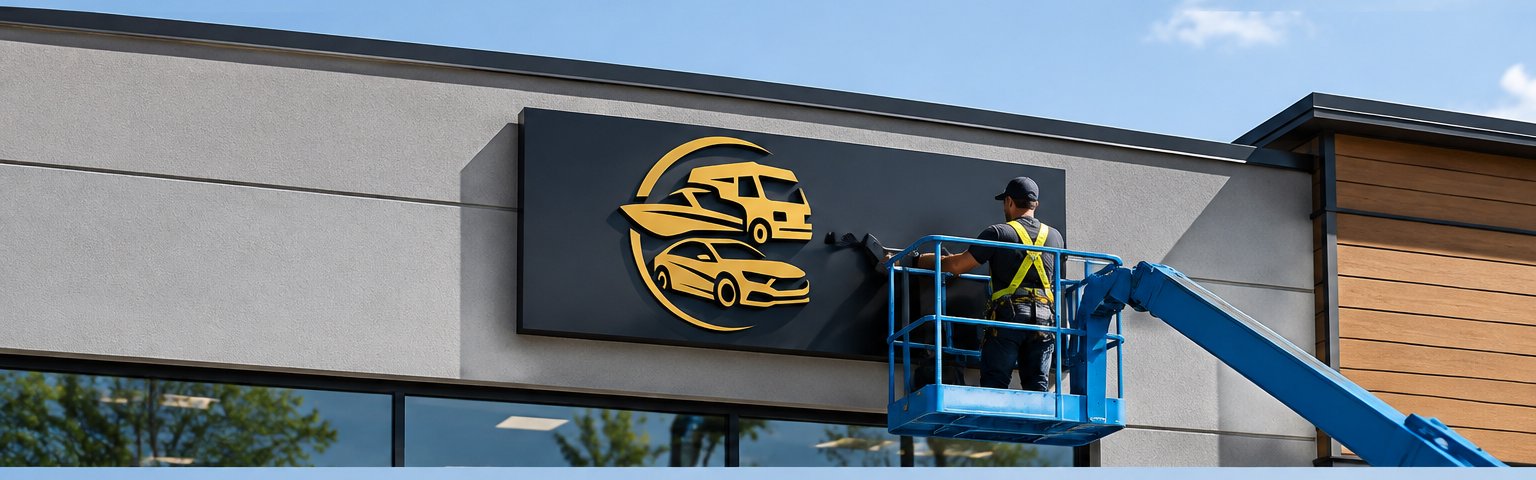
Professional installation matters for correct alignment and proper surface prep. Our team explains the reasoning in why professional installation matters for vinyl graphics.
Outdoor Sign Material Cost: What Drives the Price Up or Down
Outdoor sign material cost is driven by substrate choice, sign size, print method, lamination, and installation complexity.
Pricing depends on dimensions, quantity, and site conditions. For current pricing, request a quote from Pearl Wrapz.
Local Codes, Permits and Accessibility Rules for Business Signs
Business signs are often regulated at the local level, so confirm requirements with your local permitting office before ordering a permanent sign.
Accessibility matters too: the ADA Standards for Accessible Design govern signage requirements in certain contexts, including tactile characters and mounting heights for permanent room and facility signs. A sign that ignores these rules can require costly replacement.
Confirm local permit requirements before ordering a permanent sign.
Get a Quote for Your Storefront, Fleet or Event Graphics
Matching outdoor signage materials for businesses to your site is the difference between a sign that lasts and one you replace in two years. The right substrate, laminate, and mounting combination protects your investment and keeps your brand legible in real conditions.
Pearl Wrapz handles projects from concept through installation, covering vehicle wraps, wall murals, storefront window graphics, and floor decals. We also install client-supplied graphics. You can see the range of commercial work on our graphics services page, or tell us about your project and we will scope the right material for your site.
Get started with Pearl Wrapz and put the right material behind your brand.
Your sign is only as good as the material and install behind it. If you are weighing options for a storefront, fleet, or event, our team can help you choose a substrate that fits your exposure and budget. Pearl Wrapz offers full-service graphics from concept to installation, specialized work across vehicle and commercial surfaces, and installation support for client-supplied graphics. Get started with Pearl Wrapz and make every square foot of your space work harder for your brand.
Frequently Asked Questions
What is the best material for outdoor business signs?
There is no single winner, because the right outdoor signage materials depend on exposure and lifespan. Aluminum and Dibond hold up best for permanent storefront and monument signs that face full sun and wind. Acrylic suits covered entrances and backlit faces. Vinyl banners and corrugated plastic fit short-term promotions and events. Match the material to how long the sign stays up and what it faces, then confirm mounting hardware is rated for the same conditions.
Is aluminum or PVC better for an outdoor sign?
Aluminum is commonly used for permanent business signage that is large or exposed to weather. PVC is lighter and can suit smaller, sheltered signs.
How long do outdoor business signs last?
Lifespan tracks material and exposure more than brand. Lifespan depends on material and exposure. Vinyl banners are generally suited to short-term and event use. Fading and peeling are often linked to the printed face and laminate.
What drives outdoor sign material cost?
Size, substrate, print method, lamination and mounting hardware set the price. A rigid aluminum panel with cast laminate and stainless mounts costs far more than a temporary vinyl banner of the same dimensions. Ask for a quote that itemizes substrate, face material and installation so you can compare like for like.