 Comparison
Vehicle Wrap vs Facebook Ads: Cost Comparison for Local Business
Last Updated: October 26, 2026
Quick Summary
A vehicle wrap is a one-time cost that keeps generating exposure while the vehicle drives, while Facebook ads are a recurring expense that stops when spending stops. Compare them over the same time horizon, using cost per customer, not impressions or headline prices.
- Compare wrap and Facebook costs over the same defined time horizon, not a single headline figure.
- A full wrap typically costs between $2,500 and $5,000, according to one third-party roundup.
- Estimated wrap CPM of $0.04 to $0.15 is well below most paid digital placements, though assumptions are unstated.
- Set a baseline for leads and close rate for 60 to 90 days before the wrap or campaign launches.
- Use a dedicated phone number, QR code, or unique URL on the vehicle to attribute leads to the wrap.
Table of Contents
- Why Compare a Vehicle Wrap With Facebook Ads
- Upfront Vehicle Wrap Costs by Vehicle Type
- Facebook Ads Cost Per Result and Budgeting
- Comparing Cost Per Impression and Reach
- Commercial Vehicle Wrap Lifespan and Cost Over Time
- Vehicle Wrap Advertising ROI and How to Measure It
- Vehicle Wrap Advertising Examples and Choosing Your Next Step
- Frequently Asked Questions
Why Compare a Vehicle Wrap With Facebook Ads
Most local owners weigh a vehicle wrap against Facebook ads as if they were the same thing. They are not. A wrap is a one-time physical asset that keeps working while the vehicle drives.
Compare the two on a defined time horizon, not a single headline figure.
A wrap is judged by how long it runs and how many people see it. Facebook ads are judged by spend, targeting, and whether anyone takes action.
One vehicle-wrap marketing roundup reports a cost of $0.40 per thousand impressions for wraps, compared with $5.00 for television (Gitnux, 2026) (Vehicle Wrap Marketing Statistics (2026): Expert Analysis).
Upfront Vehicle Wrap Costs by Vehicle Type
Cost estimates vary. One vehicle-wrap roundup puts a full wrap between $2,500 and $5,000 (Capital Wraps, 2026). Another lists small cars and compact vehicles at $1,800 to $3,500, sedans and SUVs at $2,500 to $4,500, and pickup trucks starting at about $3,000. These third-party ranges should only frame your own budget.
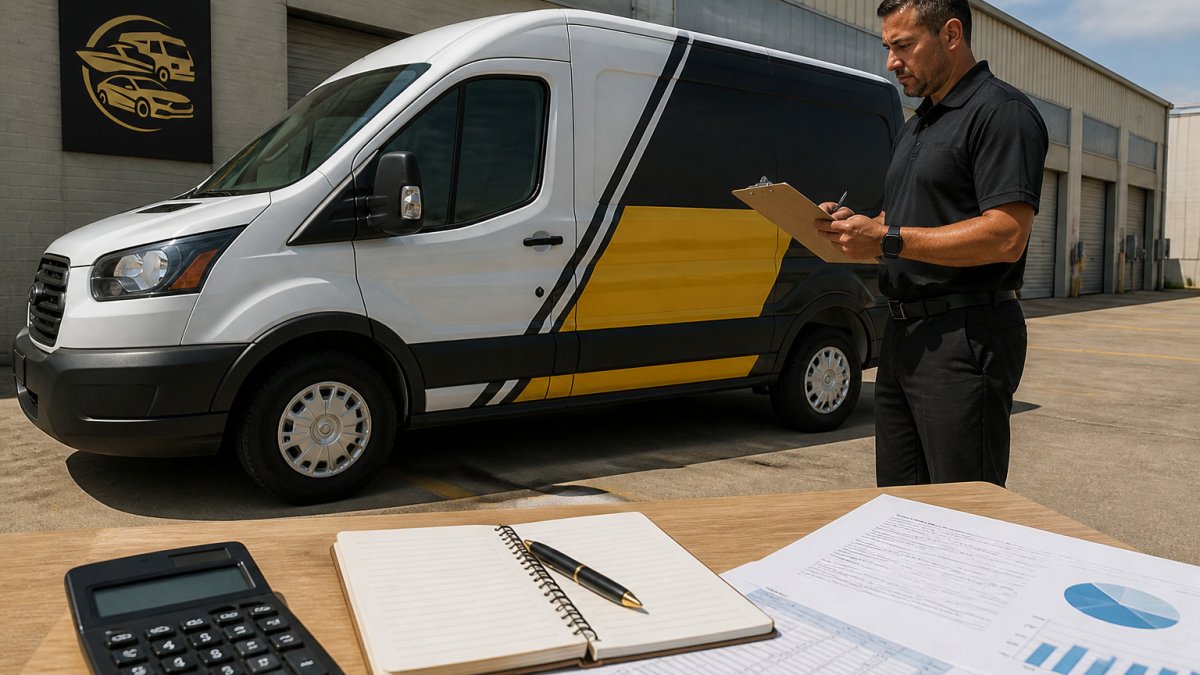
For a figure built around your vehicle, request a practical project estimate from Pearl Wrapz & Graphics. Business owners weighing commercial truck work can review the commercial truck wrap service.
Facebook Ads Cost Per Result and Budgeting
Facebook ads are priced by auction and by the result you pay for: cost per click, cost per lead, or cost per conversion. A modest cost per click says little on its own.
One automotive benchmark puts the average cost per click for car sales on Facebook at $0.79 (Demand Local). Averages like this vary by region, season, audience, and ad quality, so they are useful only as a rough reference point.
Decide how many qualified leads you want per month, estimate your lead-to-customer rate, and work backward to the spend required. If $500 a month produces four leads and one customer, that customer costs $500.
Here is what that looks like with a simple table of the two approaches:
| Factor | Vehicle Wrap | Facebook Ads |
|---|---|---|
| Cost structure | One-time project cost | Recurring monthly spend |
| Typical measure | Cost per thousand impressions (estimated) | Cost per click, lead, or sale |
| Audience | People who see the vehicle | Targeted users on the platform |
| Pros | Works while the vehicle drives; no ongoing spend | Precise targeting; easy to adjust quickly |
| Cons | Hard to track direct sales | Costs stop when spending stops; ad fatigue |
Comparing Cost Per Impression and Reach
Cost per thousand impressions (CPM) shows how much you pay to reach one thousand views. Wraps tend to look strong here because a parked or moving vehicle can generate many views at low cost.
One estimate lists vehicle-wrap CPM at $0.04 to $0.15 (AP Signage), well below most paid digital placements.
Facebook CPM depends heavily on audience and competition, and the research supplied gives no like-for-like figure to set beside the wrap number. A wrap's impressions are broad and local, while Facebook impressions can be narrowly targeted.
A wrap on a service truck is seen by people already in your market, which suits businesses whose customers live within driving distance.
Commercial Vehicle Wrap Lifespan and Cost Over Time
The biggest mistake is ignoring time. A wrap's cost can be considered over its period of exposure; Facebook spending over the same period adds up differently. Most wrap-versus-ads articles stop at a lifespan range and a division problem. The useful version is a full cost model over a defined horizon, the only way to compare a one-time physical asset with a recurring digital expense.
What belongs in each side of the model
A fair model includes every cost the channel actually creates, not just the sticker price.
Wrap side:
- Design and artwork (often bundled into the quote, sometimes billed separately)
- Materials and printing
- Installation labor
- Surface prep or removal of an old wrap
- Maintenance: hand washing, avoiding abrasive brushes, occasional patch or panel replacement
- Removal at end of life, plus any paint or bodywork damage discovered underneath
- Vehicle downtime while the wrap is installed and removed
Facebook side:
- Media spend (the auction price you pay for impressions, clicks, or leads)
- Creative production: photos, video, copy, and refresh cycles as ads fatigue
- Campaign management time or agency fees
- Landing page or lead-form build and upkeep
- Tracking setup: pixel, conversions API, call tracking
Owners often count only media spend on the Facebook side and only the install invoice on the wrap side. That comparison flatters whichever channel they already prefer.
A worked example over 1, 3, and 5 years
Use your own quotes and your own ad budget in place of these placeholders. The structure matters more than the numbers.
| Horizon | Wrap total cost | Facebook total cost |
|---|---|---|
| Year 1 | $4,000 + $300 = $4,300 | $7,200 + $1,200 = $8,400 |
| 3 years | $4,000 + $900 = $4,900 | $25,200 |
| 5 years | $4,000 + $1,500 = $5,500 | $42,000 |
Two things jump out. The wrap's cost is front-loaded and then nearly flat, while ad cost compounds monthly. And the wrap only wins on total cost if it stays on the vehicle and keeps generating exposure for the full horizon. If the vehicle is sold, wrecked, or rebranded in year two, the math changes completely.
The variables that move the answer
- Wrap life. A garage-kept vehicle in mild climate may reach the top of the five-to-seven-year range. A daily highway vehicle in strong sun may need replacement or major panel work sooner.
- Annual mileage and route. More driving means more exposure but also more wear and more maintenance.
- Ad budget size. A small monthly budget makes the wrap look cheap over five years. A large budget makes the gap wider still, but only if the ads are producing measurable results.
- Creative refresh cost. Facebook creative fatigues. Budget for new images, video, and copy every few months, or performance drifts.
- Vehicle downtime. A week off the road has a real cost for a service business. Put a dollar figure on it.
When the wrap wins on cost over time
Run the model with your own numbers. A wrap that looks expensive on day one can be the cheaper channel by year three, and a modest ad budget can outspend it several times over by year five.
Vehicle Wrap Advertising ROI and How to Measure It
Return on investment is where most wrap comparisons fall apart, because a wrap produces no clicks to track. Measuring it takes a deliberate method that solves two problems at once: attributing leads to the wrap, and comparing wrap results to Facebook results without pretending the two produce the same kind of data.
Step 1: Set a baseline before anything changes
Record your current lead volume, source mix, and close rate for at least 60 to 90 days before the wrap goes on or the campaign launches. Track inbound calls, form fills, website sessions, and booked jobs. Without a baseline, any later change is a guess.
Step 2: Build attribution into the wrap itself
- Dedicated phone number. Put a tracking number on the vehicle that appears nowhere else. Inbound calls to that number are attributable to the wrap.
- Unique URL or landing page. Use a short, memorable web address printed on the vehicle that redirects to a page built for wrap traffic. Compare sessions and conversions on that page to your site baseline.
- QR code. Place a QR code on the rear or side panel that routes to the same dedicated landing page. QR scans are a clean, countable signal, especially for parked vehicles.
- Promo code. A code shown only on the vehicle, redeemable in person or online, ties redemptions to the wrap.
- Campaign tags. If the wrap drives traffic to a page with UTM parameters baked into the QR or short link, your analytics will separate wrap traffic from everything else.
- Customer survey. Ask every new customer how they found you, with "saw the vehicle" as an explicit option. Log the answers consistently.
None of these is perfect. Together they give you a measurable signal where none existed.
Step 3: Measure Facebook with the same discipline
On the Facebook side, use the platform's conversion tracking plus your own analytics. Tag every campaign and ad set to separate channels, and use one definition of a qualified lead across both. If a wrap call and a Facebook form fill both count as leads, they should meet the same qualification bar.
Step 4: Compare outcomes, not impressions
A wrap impression and a Facebook impression are not equivalent. A wrap impression is an estimate of exposure, someone may have glanced at the vehicle, or not. A Facebook impression is a served ad, also not proof of attention. Neither is a sale.
So compare at the outcome level:
| Measure | Wrap | |
|---|---|---|
| Exposure | Estimated impressions from mileage and route | Served impressions and reach |
| Response | Tracking calls, QR scans, promo redemptions | Clicks, form fills, calls |
| Qualified leads | Calls and forms meeting your criteria | Leads meeting the same criteria |
| Customers | Closed jobs attributed to the channel | Closed jobs attributed to the channel |
| Cost per customer | Total wrap cost over life ÷ attributed customers | Total spend ÷ attributed customers |
That last row is the only number that lets you compare the two honestly. Everything above it is an input.
Step 5: Account for what each channel cannot tell you
A wrap cannot be credited with every sale that follows a truck sighting. Some customers see the vehicle, search your name online, then convert through a channel you can track.
Common mistakes to avoid
- Counting impressions as sales on either channel
- Comparing a wrap's lifetime cost to a single month of ad spend
- Failing to set a baseline before launch
- Using different lead definitions for each channel
- Ignoring the customers who saw the wrap but converted through another touchpoint
Avoid these and the comparison becomes far more reliable. The goal is not to prove one channel wins. It is to know your cost per customer on each, over the same period, using the same definition of a customer.
Vehicle Wrap Advertising Examples and Choosing Your Next Step
Neither approach is universally better.
To see actual installations, review the project gallery of recent vehicle wraps and graphics from Pearl Wrapz. If you are ready to compare options for your own fleet or storefront, explore vehicle wraps and fleet graphics.
Frequently Asked Questions
What does cost per result mean on Facebook ads?
Cost per result is the average amount you spend for each outcome your campaign is optimized for, such as a lead, a click to your website, or a purchase. It is calculated by dividing total ad spend by the number of results in the same period. Because the metric depends on the objective you choose, compare it only against campaigns with the same goal. A lead-form campaign and a traffic campaign will not produce comparable numbers, so define the result before you compare a vehicle wrap against paid social.
How long does a commercial vehicle wrap last?
Capital Wraps estimates a full vehicle wrap lasts 5 to 7 years. Actual life depends on the vinyl quality, installation, how much sun and weather the vehicle sees, and whether it is washed and maintained properly. Fleet vehicles that are driven daily in the Texas heat may show wear sooner than a vehicle parked indoors. Ask any installer for the film warranty and the expected service life for your specific use before you budget.
How much does a business vehicle wrap cost?
Contact Pearl Wrapz through pearlwrapz.com for a quote for your vehicles.
Is a vehicle wrap cheaper than Facebook advertising over time?
The answer depends on what you count as a result. Compare total cost over the same period, and state clearly whether you are measuring exposure or conversions.