 How-to
How to Plan Custom Wall Mural Design for Businesses
Last Updated: November 15, 2026
Quick Summary
A custom wall mural design for businesses starts with defining each wall's job, audience, and brand message before any artwork is created. Match the design and material to the space, prepare high-resolution artwork, measure the wall exactly, and schedule installation around your operating hours to avoid downtime.
- Write one sentence per wall defining its audience, emotion, and brand element as the design brief.
- Send original high-resolution image files and vector logos, never screenshots or social media downloads.
- Peel-and-stick wall covering suits short-term campaigns and rented spaces, not permanent lobby walls.
- Measure width and height at the widest and tallest points, then subtract doors, outlets, and furniture.
- Compare quotes on identical scope, since a low quote excluding wall preparation is a smaller scope.
Table of Contents
- Start With Brand Goals, Not Artwork
- Commercial Wall Mural Ideas That Match Your Space
- Custom Wall Murals From Photo: Preparing Artwork That Prints Clean
- Choosing Custom Wall Coverings by Business Environment
- Measuring Walls and Estimating Project Cost
- Business Wall Mural Installation Without Downtime
- Get a Quote for Your Custom Wall Mural Design
- Frequently Asked Questions
Start With Brand Goals, Not Artwork
A custom wall mural design for businesses works best when it starts with a defined job, not a mood board. A strong mural answers three questions before anyone opens a design file: who sees this wall, what should they remember, and what action should follow.
Define the Wall's Job Before You Design It
Every wall in your building has a different audience and a different job. A lobby mural greets prospects and new hires.
Write one sentence per wall: "This wall should make [audience] feel [emotion] and notice [brand element]." That sentence becomes your design brief.
Three common jobs we see:
- First impression: reception and entry walls that carry your logo and core message
- Culture and morale: break rooms and hallways that reinforce company values for employees
- Promotion: seasonal or campaign walls tied to a launch, event, or product line
A common mistake is choosing artwork because it looks good on a designer's screen. A bold abstract pattern that reads fine on a monitor can overwhelm a small reception wall.
If your goal is branded office graphics that support business goals rather than pure decoration, office wall graphics shows how we approach that work for Texoma businesses.
Commercial Wall Mural Ideas That Match Your Space
The best commercial wall mural ideas are the ones that fit the room they live in.
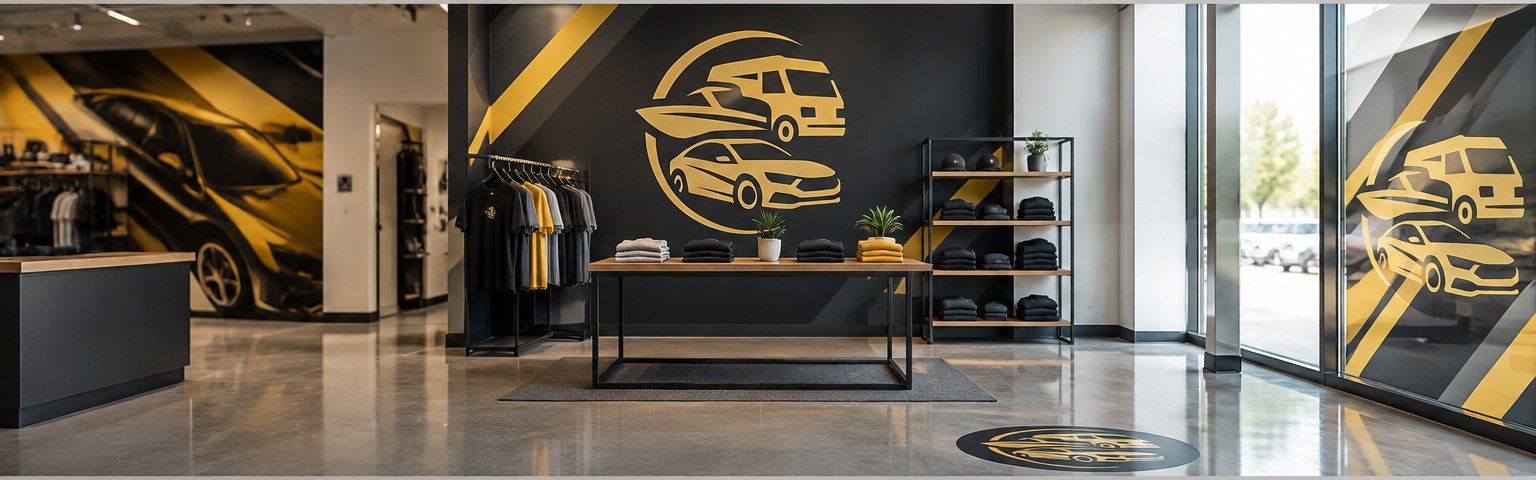
Reception and lobby murals carry the heaviest branding load.
Office and workplace branding lives in hallways, meeting rooms, and stairwells.
Retail space murals should support the products on the floor. A mural that feels connected to the merchandise can make the whole retail space more cohesive, and Vireous.Shop can help shape that connection through thoughtful custom wall art.
Restaurant interiors reward atmosphere. Fine art, traditional patterns, and warm textures set a mood before the food arrives.
Promotional and event walls are short-term by design.
Style categories to pick from: abstract art, traditional patterns, fine art reproductions, photography and photo murals, and typography-led graphics.
To see the actual service behind these ideas, including reception walls and office branding, browse our wall murals and interiors work.
Custom Wall Murals From Photo: Preparing Artwork That Prints Clean
Custom wall murals from photo files succeed or fail on image resolution. A photo that looks sharp on your phone can turn into a blurry, pixelated wall once it is scaled to full size.
Larger walls need larger source files. A phone snapshot is rarely enough for a large feature wall.
What to send:
- The original image file, not a screenshot or a file pulled from social media
- Vector logo files (AI, EPS, or SVG) rather than a small PNG
- Brand color codes so the print matches your other materials
- Any text you want on the wall, spelled out exactly
Check text size and logo placement on a proof at the wall's proportions, not on your phone.
A common mistake is approving artwork before checking how it scales. Ask for the proof at true proportion and view it from the same distance visitors will stand.
Choosing Custom Wall Coverings by Business Environment
Custom wall coverings should be selected for the room, not just the artwork. The same printed design behaves differently in a humid kitchen, a sunlit lobby, and a high-traffic hallway. The right question is not "which material looks best" but "what will this wall face every day for the next five years."
Here is how material choice can be matched to environment, including the maintenance reality of each space:
| Environment | What Matters Most | Material Direction | Cleaning and Upkeep |
|---|---|---|---|
| Office lobby and reception | Clean finish, long life, easy cleaning | Smooth commercial-grade wall covering | Damp cloth with mild soap; avoid abrasive pads |
| Retail floor | Scuff resistance, frequent cleaning | Durable printed wall covering with a protective overlaminate | Spot-clean scuffs; periodic full wipe-down |
| Restaurant and kitchen areas | Moisture, heat, and grease exposure | Wipeable, moisture-tolerant material | Degreaser-safe cleaning; check seams near heat sources |
| Schools, clinics, public spaces | Safety and code compliance | Fire-rated material where required | Disinfectant-safe surface; confirm cleaner compatibility |
| Temporary promotions | Easy removal, low residue | Peel-and-stick, self-adhesive vinyl | Light dusting only; plan removal date at install |
Two terms come up constantly. Peel-and-stick wall covering is a self-adhesive material that applies directly to a prepared wall and removes with less residue, which makes it a good fit for short-term campaigns and rented spaces. Commercial-grade material is built for daily wear and cleaning in busy spaces, and it usually carries a protective top layer that resists scuffing and moisture.
Match the Material to the Cleaning Routine
The most overlooked specification is how the wall will be cleaned. A material that survives a damp cloth can fail under daily disinfectant spray. In food-service areas, grease and heat near cooking lines stress seams and edges first. In healthcare and childcare settings, cleaning chemicals are often stronger than the material's printed surface can tolerate over years. Ask your installer which cleaners are compatible with the specified material before you approve the proof, and write that into the maintenance plan.
Plan for Sun, Humidity, and Traffic
Sunlight fades ink. A south- or west-facing lobby wall with direct afternoon sun will show color shift sooner than an interior hallway wall, even with UV-resistant inks. Humidity in kitchens, locker rooms, and entryways can lift edges if the wall was not properly primed. High-traffic corridors scuff at chair-rail height first, so a protective overlaminate pays for itself there. None of these are reasons to avoid a mural; they are reasons to specify for the room.
Know When Peel-and-Stick Is the Wrong Choice
Peel-and-stick is excellent for seasonal campaigns, trade show booths, and rented spaces where removal matters. It is a poor fit for a permanent lobby feature wall that will be cleaned weekly for a decade. A common mistake is choosing the cheapest self-adhesive option for a permanent wall. It may look fine on day one and fail under daily cleaning. Match the material to how long the mural must last, then confirm the removal plan if the space is leased.
Check local fire and building codes before specifying material in public spaces. Ask your installer to confirm what applies to your building.
Measuring Walls and Estimating Project Cost
Measure the wall before you fall in love with a design. Custom sizing depends on exact wall dimensions, minus anything the mural should not cover.
Measure width and height at the widest and tallest points, then note doors, outlets, thermostats, and furniture that will sit in front of the wall.
For a step-by-step method covering wall width, viewing distance, and furniture, our guide to choosing the right wall mural size for an office lobby walks through the measurements.
What Actually Drives the Price
Project cost depends on several factors, not one number:
- Total square footage of the mural
- Material selected for the environment, including protective overlaminate
- Design complexity and any custom illustration or photo retouching
- Wall preparation needed before installation, such as patching, priming, or removing old coverings
- Installation access, ceiling height, scaffolding, and after-hours scheduling
- Removal or replacement of an existing mural
We do not publish flat prices because every wall is different. The honest approach is to measure, share photos of the wall, and request a quote based on the actual space. That gives you a real number instead of a guess.
Build a Budget That Includes the Whole Lifecycle
The purchase price is only part of the cost of ownership. A practical budget line includes design and proofing, material and printing, wall preparation, installation, and a maintenance allowance for cleaning supplies and minor touch-ups. Over a multi-year horizon, a durable commercial-grade material may be worth comparing against cheaper films on annualized cost. Ask your installer for the expected service life of each material option and compare annualized cost, not just the upfront quote.
Compare Quotes on the Same Scope
Quotes are only comparable when they cover the same work. Ask each vendor to itemize square footage, material and overlaminate, wall prep, installation labor, and disposal of old materials. A low quote that excludes wall preparation is not a lower price; it is a smaller scope. Confirm whether the quote includes a proof, a site visit, and a post-install inspection, and whether after-hours work carries a premium.
Watch out: approving a quote before confirming wall preparation and cure time is the most common way a budget overrun starts. Prep and scheduling surprises cost more than the print itself.
Business Wall Mural Installation Without Downtime
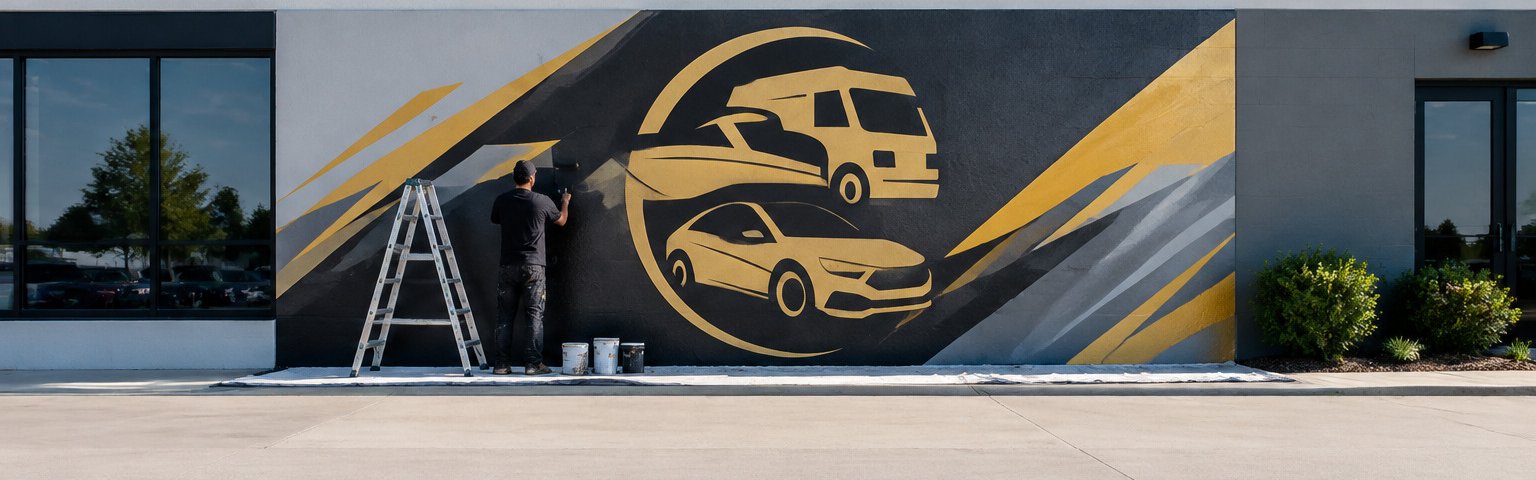
Business wall mural installation can usually happen without closing your doors.
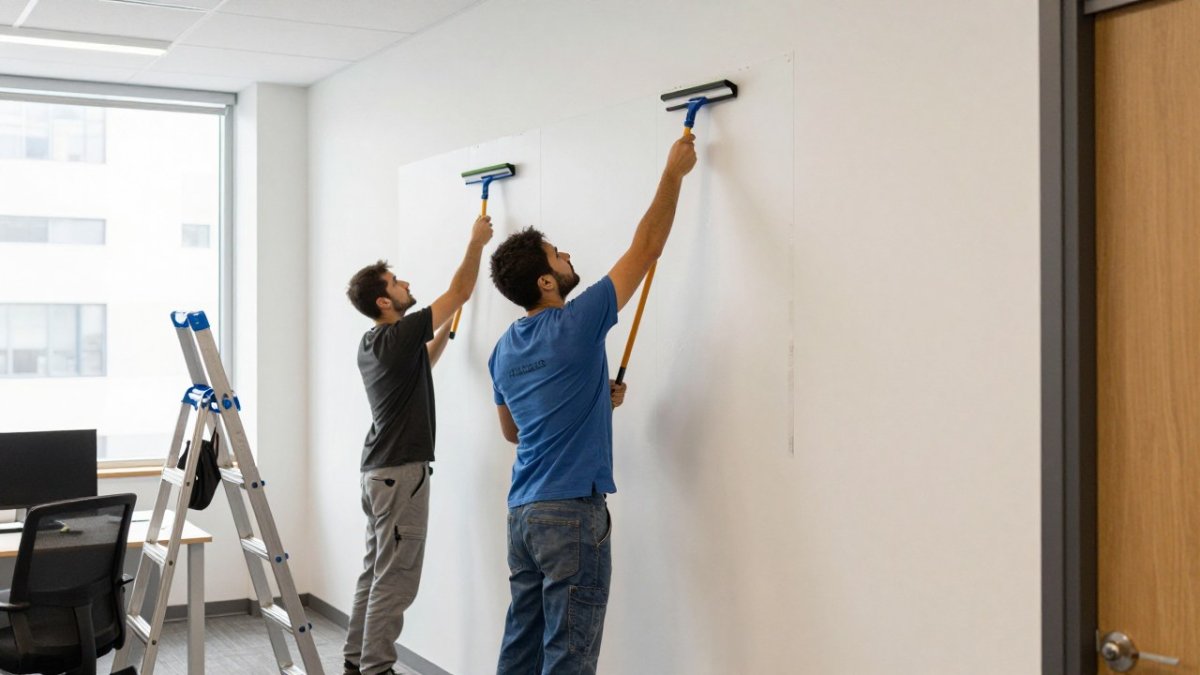
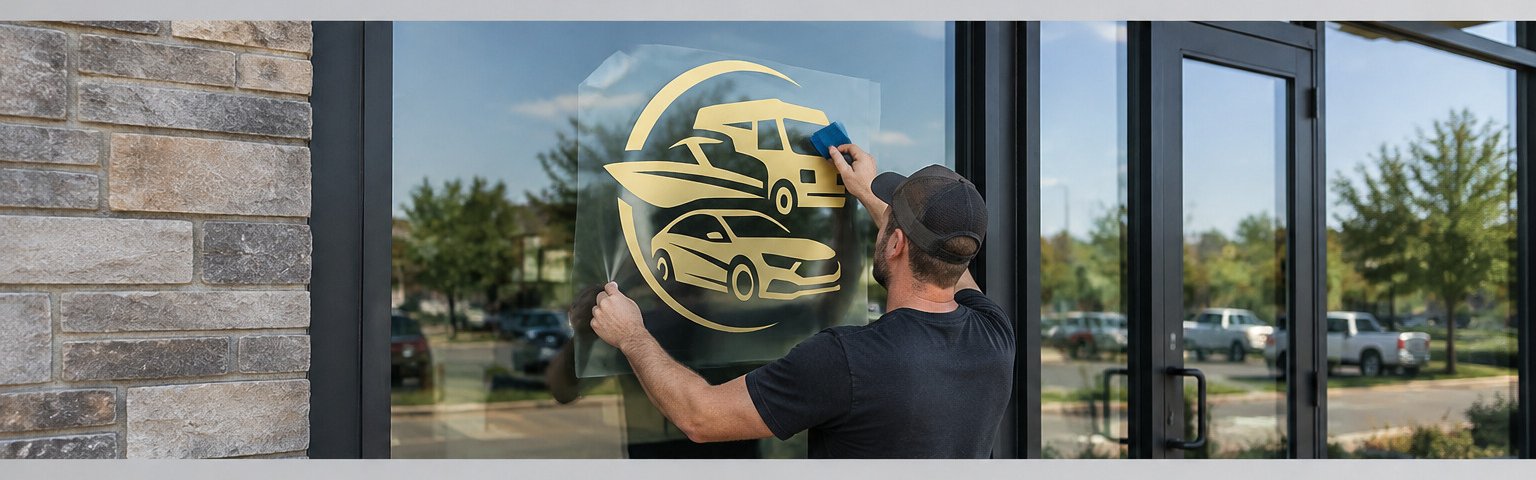
Professional installation follows a clear sequence: wall preparation, panel layout, application with a squeegee to remove air bubbles, trimming at edges, and a final inspection.
Scheduling options that protect your business:
- After-hours installs: evenings or early mornings for retail and restaurants
- Section-by-section work: complete one wall at a time so the space stays usable
- Weekend installs: for offices that empty out Friday afternoon
- Phased rollouts: start with the highest-impact wall, then add others
Preparation matters as much as the install. Walls should be clean, dry, and in good condition.
For a full walkthrough of how professional indoor wall mural installation works from design through install, read our indoor wall mural installation guide.
Watch out: scheduling the mural before the paint has cured can cause problems. Build the cure time into the timeline.
Get a Quote for Your Custom Wall Mural Design
A quote request is the fastest way to turn a wall idea into a real plan. Bring three things and the process moves quickly: photos of the wall, rough measurements, and your brand files.
Request a quote for your space and current pricing. Tell Pearl Wrapz & Graphics about your vehicle, storefront, wall, window, floor or graphics project. Pricing depends on quantity, dates, and delivery, so visit the Pearl Wrapz website for current prices or a quote.
Pearl Wrapz provides visual branding solutions, including custom wall murals, storefront window graphics, floor decals, and vehicle wraps, and serves businesses in North Texas and southern Oklahoma. We also act as a local installation partner for client-supplied graphics.
Ready to make that first impression count? Pearl Wrapz designs and installs custom wall murals, office wall graphics, and storefront graphics tailored to your space and your brand.
Frequently Asked Questions
How do you design a custom wall mural for a business?
Start with what the wall needs to do: welcome clients, reinforce brand identity, or divide a workspace. Then measure the wall, gather high-resolution artwork or photos, and choose a material that suits the surface and traffic level. A design partner turns those inputs into a scaled proof you approve before printing. Pearl Wrapz provides visual branding solutions, including custom wall murals, from concept through installation.
What materials are used for custom wall murals?
Most commercial murals use printed vinyl or textured wall covering in peel-and-stick or traditional adhesive formats. For high-traffic areas, specify a commercial-grade material with a protective laminate; for corridors and lobbies, ask your installer whether fire-rated material applies to your building. Smooth drywall, brick, and glass each call for different adhesives and surface prep. Ask your installer which material fits your wall type before artwork goes to print.
Can a business use its logo in a custom wall mural?
Yes, and it is one of the most common requests. Supply vector logo files rather than screenshots so edges stay sharp at wall scale. Keep the logo sized to read from the actual viewing distance, and leave clear space around it. A wall mural design that repeats the logo at three different sizes usually looks cluttered; one strong placement plus supporting brand colors works better in lobbies and reception areas.
How long does it take to design and install a custom wall mural?
Timelines depend on wall size, artwork readiness, and material lead time. Simple designs with print-ready files move faster than projects that need photo retouching or original illustration. Build review time into your schedule for approvals, and confirm current lead times with Pearl Wrapz when you request a quote.